
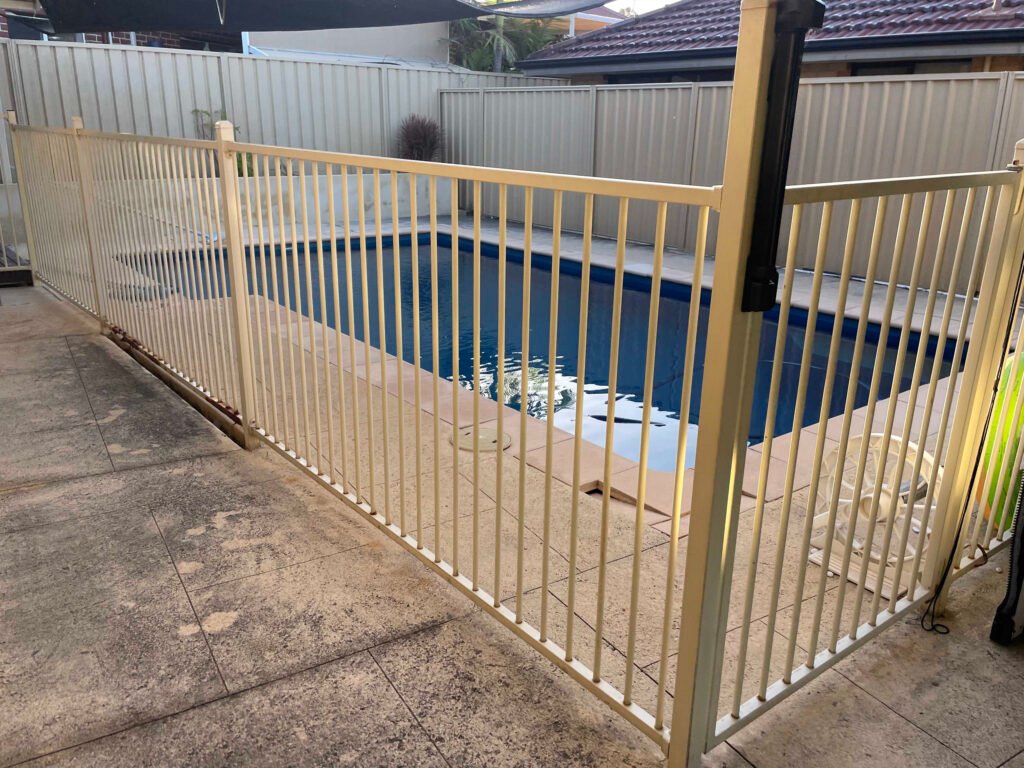
In WA, a pool fence must be at least 1.2 metres (1200mm) high, measured from the finished ground level on the outside of the barrier. The gate must self-close, self-latch, and swing outward, away from the pool, with the latch release at least 1.5 metres above the ground, or shielded and set back if mounted lower. Any gap under or through the barrier must not exceed 100mm.
Pool fence regulations in Western Australia come from the Building Act 2011 and the Building Regulations 2012, backed by Australian Standard AS 1926.1. These pool fence laws WA relies on, together with the wider swimming pool fence regulations in the standard, set the safety standards and barrier requirements every pool owner has to meet.
That applies to any swimming pool or spa deeper than 300mm, in-ground, above-ground, or portable. As the owner, you’re responsible for keeping a compliant safety barrier in place that restricts access by young children from every side, the street, next door, and the house itself, not just the pool side of the yard.
This requirement excludes some remote parts of WA. If you’re in a remote area, check the safety barriers for excluded areas fact sheet before assuming the rules below apply to your property.
Never Prop the Gate Open
This is the single biggest cause of pool drowning deaths in WA, so it comes before any dimension. Most incidents happen because someone propped the gate open, the latch failed, or the gate didn’t close properly. Never prop a pool gate open, even briefly, and check the latch and hinges regularly rather than waiting for them to fail.
Pool Fence Height WA: How Tall Does a Pool Fence Need to Be?
Your pool fence must be at least 1.2 metres (1200mm) high, measured from the finished ground level on the outside of the barrier.
That’s the pool fence height requirement to work to, whether you’re building new or checking a fence that’s already there.
A few extra pool fence height regulations apply on top of the base pool fencing height:
- If a boundary fence or boundary wall forms part of your barrier, it also needs to meet the 1.2m minimum.
- Where the barrier has horizontal rails, the highest low rail must sit at least 1100mm below the top of the fence, since horizontal rails can act as footholds.
- Do not place climbable items, such as potted plants, BBQs, or raised garden beds, within 1200mm of the external fence line.
- No climbable object can sit within 300mm of the fence on the inside.
Which Standard Applies to Your Pool Fence
The pool fence rules WA sets out aren’t a single fixed set of pool fencing requirements. What applies to you depends on when your pool was installed:
- Installed from 1 May 2016 onwards: must comply with the Building Code of Australia, which adopts AS 1926.1-2012 (barrier construction) and AS 1926.2-2007 (barrier location and non-climbable zones).
- Installed before 1 May 2016: may comply under the earlier AS 1926.1-1993 standard. You can upgrade to the current requirements, but that requires a building permit from your local council.
- Approved before 5 November 2001: a specific concession may allow a wall with a door to count, provided that door meets AS 1926.1-1993.
Confirm your pool’s approval date with your council before relying on any fence spec, since the wrong standard means the wrong numbers. The Rules for Pools and Spas booklet sets out the full technical detail for each standard.
Gate, Latch, and Hinge Requirements
Every gate must self-close and self-latch from any open position, and it must swing outward, away from the pool.
Hinges: hinges must reliably return the gate to a closed position on their own. Faulty or worn hinges are a recognised compliance failure point.
WA’s building regulator has issued clear guidance on gate hinges in Industry Bulletin 123, and there have been product safety recalls for faulty pool gate latch assemblies.
If your gate has a recalled or worn latch, replace it at once; don’t wait for your next inspection.
Pool Gate Latch Height in WA
In WA, the pool gate latch release must be at least 1.5 metres (1500mm) above the ground. If it’s mounted lower, it must be shielded inside the gate using the second method below.
The latch release must sit out of a child’s reach, using one of two methods:
- The latch release sits at least 1.5 metres (1500mm) above the ground, or
- The latch sits inside the gate, at least 150mm below the top, shielded so no gap wider than 10mm exists within 450mm of it.
Gaps and Openings
Any gap under, through, or beside the barrier must not exceed 100mm. This applies to the gap under the gate, spacing between vertical members, and any junction where the barrier meets a wall or post.
Doors and Windows in the Barrier
If a house wall is part of your barrier, any windows or sliding doors in that wall need child-resistant devices, or they leave a gap in the barrier.
Doors: for pools approved after 5 November 2001, a door usually cannot be part of the safety barrier, even if it’s self-closing and self-latching. Exceptions are narrow: pools approved before that date, or specific council approval.
Pet doors are never permitted as part of a barrier. See the replace your child-resistant door fact sheet for guidance on compliant alternatives.
Fence Inspections
New pools: local governments must inspect a new pool’s safety barrier within 30 days of becoming aware the pool is complete, whether the barrier is temporary or permanent. Builders must also lodge a Notice of Completion (BA7) with the council within 7 days of finishing the work.
Owners should arrange this first inspection right after handover and keep the barrier’s compliance documents ready to show the inspector.
Existing pools: local governments must inspect private swimming pool and spa barriers at least once every four years, even if you don’t sell the property.
A sale or lease often triggers an extra inspection, and settlement usually requires a current compliance certificate. If an inspector finds a problem, you’ll get a notice requiring rectification within a set timeframe.
Penalties for Non-Compliant Fencing
A non-compliant barrier can mean fines, a rectification notice, and greater liability if an accident occurs. Amounts vary by council and can escalate for repeat or unresolved non-compliance.
Fence Compliance FAQ
How tall does a pool fence need to be in WA?
At least 1.2 metres (1200mm) above the finished ground level, measured on the outside of the barrier.
Can a hinged gate open into the pool area?
No. Gates must always open outward, away from the pool.
How soon after my pool is finished does it need to be inspected?
Within 30 days of the local government becoming aware the pool is complete. This is separate from, and comes before, the ongoing four-yearly inspection cycle.
Can landscaping affect fence compliance?
Yes. Garden beds, furniture, and other items near the barrier can create climbing access, so they should be moved or removed.
Can a door count as part of my pool barrier?
Only in limited cases, generally only for pools approved before 5 November 2001, or with specific council approval.
What’s the most common reason pool gates fail inspection?
Propped-open gates, faulty or worn latches, and gates that don’t self-close properly, including recalled latch assemblies still in use on older gates.
Are pool safety fence requirements the same for above-ground and in-ground pools?
Yes. The same swimming pool fence rules apply to both, along with portable pools, once the water depth exceeds 300mm.
Where to Get Help
Contact your local council’s building or health department for suburb-specific guidance, or engage an accredited pool safety inspector.
Full official guidance is available on the WA.gov.au swimming pool safety barrier page. If you need a new pool fence built to current requirements, MKB Fencing installs compliant pool fencing Perth.