
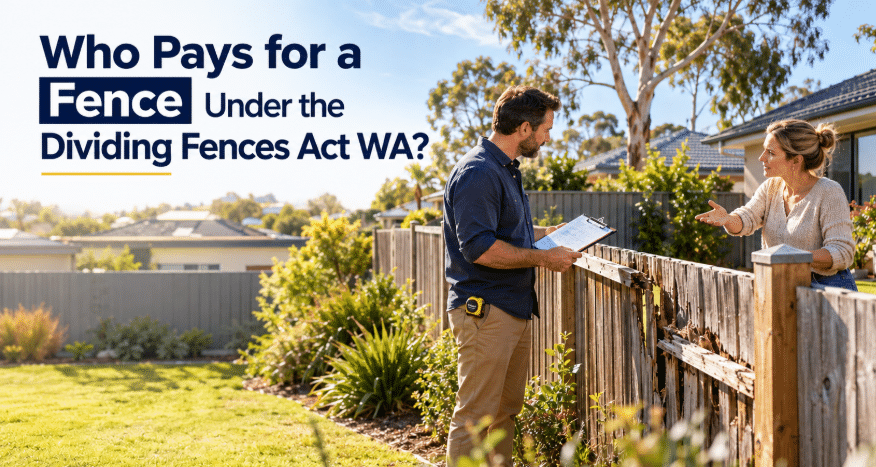
Got a knackered fence and a neighbour who won’t chip in? You’re not alone, mate. The Dividing Fences Act 1961 sorts this out in Western Australia. In short, you and your neighbouring owner split the cost of a sufficient fence. And if you can’t agree, the Magistrates Court steps in.
So here are the rules, the deadlines and the common dramas. Just so you know, this is general info, not legal advice.
Dividing Fences Act Western Australia basics
The Act does three main jobs. It shows how neighbours share the cost of building and fixing a dividing fence. It explains how to pin down the boundary. And it lets a court settle a fight when you can’t.
Your fence can sit on the common boundary of adjoining lands or on a line close by. Either way, a written agreement with your neighbour beats the Act. So get your deal signed.
Now, what’s a “sufficient fence”? Your local government decides, using local laws prescribing the type of fence for your area. For example, the Town of Victoria Park generally wants a dividing fence between 1.8m and 2.4m high.
No local law and no agreement? Then a sufficient fence is a sturdy one that can stop cattle and sheep, or whatever a court says. In suburban Perth, though, your council’s standard is the one that counts.
Who pays for a boundary fence in WA?
Under the boundary fence rules WA neighbours follow, you each pay half for a sufficient fence. Repairs work the same way. That said, a few rules catch people out:
- Upgrades: Build a fancier fence before your neighbour agrees, and you can only claim half the cost of a sufficient fence. You cop the rest. So check our Colorbond fencing cost guide before you get quotes.
- Fire or a falling tree: If fire or a falling tree wrecks the fence and your neighbour was negligent, they pay the full repair bill. For any other damage, you split the cost.
- Storms and floods: Either of you can fix the fence straight away without giving notice. Then you recover half the cost from the other owner.
- Vacant blocks: You can’t claim a contribution until the neighbour finishes a substantial building, moves into one or lets someone else move in.
- Part-built fences: If each of you built part of the fence, each of you fixes your own part.
How do you give a notice to fence in WA?
Friendly chat gone nowhere? Send a written notice. First, sign it. Then hand it over in person or send it by registered post to your neighbour’s usual or last known address. Also, check your Certificate of Title with Landgate for any covenants on dividing fences.
Your notice needs to cover:
- The boundary you want to fence
- The type of work (new fence, repair or realignment)
- The kind of fence, including material and colour
- Who will organise the work
- Where the fence will sit, especially if it’s off the boundary line
- How you’ll share the costs
The Act doesn’t ask for quotes, but a quote helps you strike a deal fast. So attach one. Plus, the WA Government dividing fences guide has sample letters you can copy, and it works as a handy dividing fences act fact sheet. For repairs, section 15 of the Dividing Fences Act 1961 shows how to make your neighbour chip in.
Notice deadlines at a glance
Deadlines trip people up, so here’s the quick list.
| Situation | Deadline |
| Neighbour disagrees with your new fence notice | Either of you can apply to the Magistrates Court within 21 days of the notice arriving |
| You send a repair notice and your neighbour doesn’t object in writing | You can go ahead and repair after 14 days |
| Neighbour disputes your claim for a fence on their vacant land | They have one month to reply in writing |
| Neighbour wants to place pegs or hire a surveyor | They have seven days |
| Agreed work doesn’t happen, or a court orders the erection of a fence with no time set | Three months, then the other owner can finish the job and recover half the cost |
Fence Height Regulations in WA (Boundary and Front Fences)
Fence height regulations in WA are set by your local council, not the Dividing Fences Act. Many councils use 1.8m for side and rear fences, some allow 2.1m by agreement, and taller fences need approval, up to about 2.4m.
Victoria Park also wants a building permit for any brick or masonry dividing fence over 0.75m high. So ring your council before you order a single panel.
Front fences face tighter rules again. And if your fence forms part of a pool barrier, read our pool fencing regulations WA guide first.
Common neighbour fence disputes (and how to sort them)
Boundary fences cause most neighbour dispute dramas in WA. Here’s how to handle the big ones.
Your neighbour won’t pay
Send the notice first. If they still refuse, either of you can apply to the Magistrates Court. The court looks at the type of fence typically constructed in your area, how you both use the land and any local laws prescribing the type of fence.
Your neighbour wants to rip the fence out
They can’t. Once you put up a dividing fence, it becomes joint property. So neither of you can remove it, alter it or damage it.
The fence isn’t on the boundary line
Disagree about the boundary of adjoining lands? Get a licensed land surveyor to pin down the line. If your neighbour reckons you don’t need a surveyor, they have seven days to place pegs where they think the boundary sits. Then you wait one month before you engage a surveyor.
If the surveyor backs their pegs, you pay the full cost. Otherwise, you split it.
You can’t find your neighbour
Try your council’s rates department or Landgate for owner details. Still no luck? Contact the Magistrates Court before you build. The court can authorise the fence. Later, you can ask the new owner for half the value of the fence.
Which side gets the good face?
The Act doesn’t say. So agree on it in writing and you’re sorted.
Who pays if my neighbour damages the fence?
It depends on the cause. If fire or a falling tree damages a dividing fence and your neighbour was negligent, they pay the full repair cost. For other damage you split it equally. After a storm or flood, either owner can repair straight away without notice, then claim half from the other. See who pays for storm damage fence repair in Perth.
Retaining walls and overhanging trees
Boundary wall regulations in Western Australia sit outside the Act. In other words, Dividing Fences Act WA retaining wall rules don’t exist. Building work involving retaining walls comes under the Building Act 2011. Your council also sets the height and encroachment rules. So check with your council before you build or knock one down.
Neighbours’ trees overhanging your property sit outside the Act too. Legal Aid WA says you can cut overhanging branches back to your boundary. You can also dig up roots and cut them back to the fence line. But don’t poison your neighbour’s tree, and don’t step onto their property without permission. Also, check for a tree preservation order first. It can ban pruning without a permit.
Can’t agree on overhanging trees responsibility in WA? The Magistrates Court settles it as a civil matter. The one exception is a tree that falls on a dividing fence. In that case, a negligent neighbour pays for the repair.
Talk first, then mediation, then court
Start with a yarn over the fence. Next, put your proposal in writing. Still stuck? Try mediation. Some councils, such as the City of Stirling, point residents to Citizens Advice Bureau mediation.
Don’t expect your local government to referee, though. The Shire of Wongan-Ballidu, for example, stays out of neighbour fence disputes. So under the law regarding fences in WA, unresolved cases end up in the Magistrates Court.
Need a quote for your notice?
A solid quote makes your notice much harder to knock back. Check out our services page or give the MKB Fencing crew a bell. We work across Perth, including Morley, Belmont, Midland, Balcatta and Victoria Park.
FAQ
How high can a boundary fence be in WA?
Your council decides. Many use 1.8m, some allow up to 2.1m by agreement, and taller fences need approval, up to about 2.4m. Check your council’s local law first.
Can my neighbour remove the boundary fence?
No way. A dividing fence is joint property, so neither of you can remove, alter or damage it. You both have to maintain it too.
What side of the fence do you give your neighbour?
The Act doesn’t say. Most people face the good side. Still, agree on it in writing to dodge an argument later.
What are the legal rules for fencing along a boundary?
The Dividing Fences Act 1961 and your council’s local laws apply. You split the cost of a sufficient fence. If you can’t agree, give written notice. And if that fails, take it to the Magistrates Court.
Can my neighbour put up a 7 foot fence?
Seven feet is about 2.1m. Many councils allow that by agreement. But you only pay for a sufficient fence, not the extra height.
How tall can a fence be around your property?
Side and rear fences follow the height rules above. Front fences face tighter limits. Solid ones are often capped around 1.2m, and taller ones usually need to be see-through. Ask your council before you build.